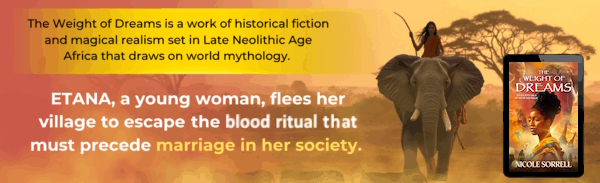
“Etana lives in an ancient North African culture in which patriarchs rule the household. When her father informs her that she’s to marry a man named Mogas, she’s not at all pleased with the prospect. Not only is Mogas much older than her, but Etana would be his third wife—and she’d likely be forced to endure a lifetime of cruel treatment from her husband and his other spouses. Etana has always felt connected to the spirit world, so when a ghost encourages her to flee her home, she listens. She makes her way into the harsh world of the wilderness beyond. The place is full of dangers, and not only from wildlife, such as lions; the threat of simply running out of water soon becomes a serious consideration. After Etana comes across a herd of elephants, she winds up befriending and taking care of them … But her newfound freedom is soon interrupted by armed men led by Capt. Tuli, the son of King Apedemak, the ruler of Nubiin. Tuli has arrived to ask Etana if she’ll work for the king, who has a penchant for using elephants in his battle plans … She knows the risks of working for the king, but she agrees to serve as an elephant whisperer in a milieu that’s starkly different from the animals she’s known.
“The novel takes place in an era that’s rarely depicted in historical fiction, a time before the rise of the ancient Egyptian civilization; as Sorrell informs readers in an afterword, “Specific information surrounding Nubian religion ca. 3300 B.C.E. is largely unknown.” In the skilled author’s hands, it’s a world where a large river flows “to the end of the world and into the stars” and a daughter can be married off for the price of five pelts … The text also incorporates such beliefs as Etana’s devotion to a figure called the Beastgod, whom she sees as responsible for the “creation of animals, from lowly worm to great elephant.” It’s a multifaceted and likely unfamiliar environment that readers will be happy to explore, just as Etana herself does. To add to the intrigue, Etana faces troubles that go beyond simply controlling the king’s elephants. Not all of King Apedemak’s men are happy about her presence—one, in particular, even wants her dead … An imaginative, adventure-filled quest in an intriguing setting.” –Kirkus Reviews
“Nicole Sorrell is doing something ambitious here: writing an epic that reads like a living folktale and a carefully researched historical fantasy at the same time. The prose leans ceremonial—rich with invocations, offerings, and named gods—so the book often feels like it’s being spoken beside a fire rather than presented in a modern, minimalist narrative style. That approach works because Etana’s voice remains stubbornly human inside the myth. When she’s angry, she’s not “performatively rebellious”; she’s furious in a way that makes sense for a girl watching her sister be swallowed by tradition and her household shaped by fear and power.
“The book’s strongest emotional choice is centering elephants as more than “cool set dressing.” Their presence changes the moral texture of the story. Etana’s bond with them gives her tenderness without softening her edge, and it also provides a living counterpoint to human cruelty: elephants become memory, kinship, patience, and cooperation—values the human world repeatedly fails to uphold. This animal/human connection is one of the novel’s most distinctive features …
“Etana herself is compelling because she’s built from contradictions: brave but not invincible, principled but not always gentle, spiritually open yet frequently angry at gods and people alike. The story doesn’t excuse the culture that harms her, but it does show how it perpetuates itself—through silence, threat, and the way survival can turn victims into enforcers. The “womanhood” thread is heavy, and it should be. It’s not there for shock value; it’s the engine of Etana’s refusal and the reason her freedom has teeth …
“… The frame of story-as-legacy—what is remembered, what is forgotten, and who carries hope forward—gives the book a lasting aftertaste.” —Book Nerdection
“Etana wins not by brute force but by using intelligence as force … it reinforces the book’s core argument: strength isn’t only what a society has historically worshiped; strength is also what it has dismissed.” —Book Nerdection