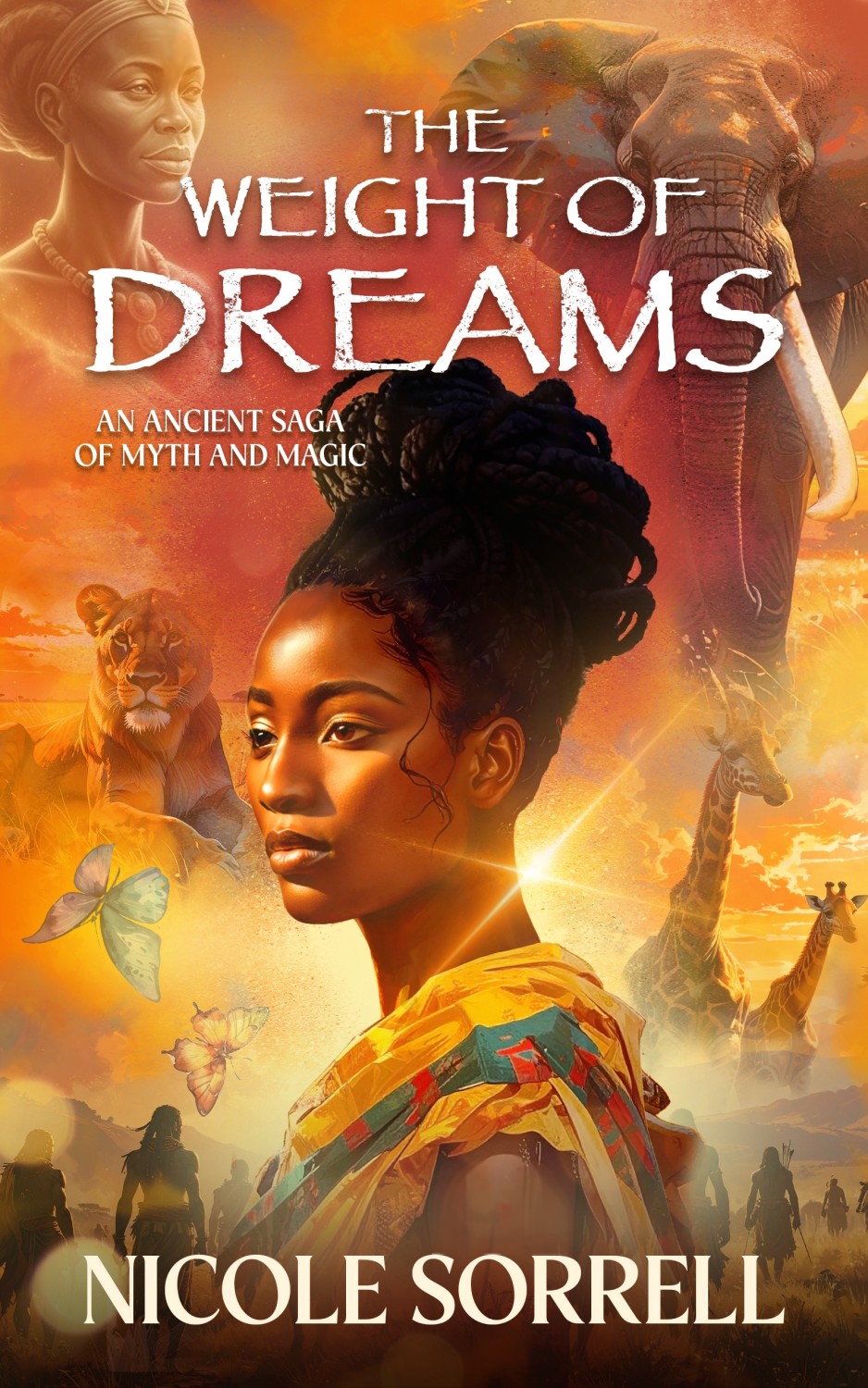
The Weight of Dreams:
An Ancient Saga of Myth and Magic

A luminous tale of spirit, survival, and destiny.

Nubia, 3300 BCE…
To avoid the Womanhood Ritual that broke her sister, Etana flees into the wilderness.
Under the watchful eyes of the Beastgod and with his gift that allows Etana to speak to elephants, she is invited by a powerful god-king to train his elephant for battle. But in a world where loyalty is eternal and power demands sacrifice, who will she become when she loses everything she holds dear?
For fans of Madeline Miller, Alice Hoffman, and Isabelle Allende, The Weight of Dreams’ magical realism and atmospheric prose is infused with the rhythms of oral tradition and cultural memory. It illuminates spiritual resilience, feminine power, and the living bond between humans and nature.  
This luminous work of historical, literary fiction is infused with magical realism—perfect for readers who believe the past still speaks, and sometimes, it sings.

In The Weight of Dreams you’ll discover:

  • A heroine’s journey that blends history, myth, and spiritual resilience.
  • A deeply immersive setting that transports you to ancient Africa.
  • A story told with the cadence of oral tradition, where every page feels timeless.
  • Layers of court intrigue, betrayal, prophecy, and transformation.
  • An emotional and unforgettable tale that lingers long after the final chapter. 

Perfect For Readers Who:

  • Enjoy literary fiction with lush, evocative storytelling.
  • Relish magical realism and myth-infused narratives.
  • Appreciate historical fiction with new, unusual settings.
  • Are drawn to strong female protagonists and journeys of empowerment.
  • Seek a rich, discussion-worthy novel that explores culture, power, and destiny for their book clubs.

Book club questions

  1. Which scene or chapter in The Weight of Dreams was the most striking to you? Why?
  2. How did the book’s theme of feminism relate to our world today?
  3. What was Etana’s reaction when Captain Tuli and the contingent asked her to go with them? How did she make the decision?
  4. Etana was angry when she felt Tuli broke his promise to her. How have you dealt with somone who failed to keep a promise?
  5. In what ways did Etana receive support from the ghost of Anjirũ’s house?
  6. Which of Griot’s tales did you like the best? What purpose did his stories serve?
  7. Why did the people of Ényòn and Nubiin accept the Ritual of Princes? Why did the ritual trouble Etana?
  8. What was the ancient concept of kingship? What role did it play in Etana’s fate?
  9. Did you agree or disagree with Etana’s view that every species of animal and plant in a particular environment are inextricably intertwined? Explain.
  10. The sons of King Apedemak have very different statuses in society. Why was this?
  11. What happened when Etana was presented to the king? What were the consequences?
  12. What do you think motivated The Five–Jatau, Kamau, Lawali, Ukko, and Tuli–to protect Etana?
  13. What purposes did rituals fulfill in Etana’s society?
  14. The use of elephants in the book was fictional, but do you think it’s possible elephants could have been used in this way in ancient Africa?
  15. What effect did the battle have on Tuli and Etana’s relationship?
  16. Why do you think the king asked Etana to become an advisor?
  17. Did learning more about the cause of Idun’s catatonic state at the end of the book change your view of Etana’s flight from her village at the beginning? Why or why not?
  18. How would the story have changed if Etana did not return in the end?

Etana “… is compelling because she’s built from contradictions: brave but not invincible, principled but not always gentle, spiritually open yet frequently angry at gods and people alike.” 

Book Nerdection

Step into a tale where gods whisper in dreams, elephants carry memory, and courage rewrites destiny.